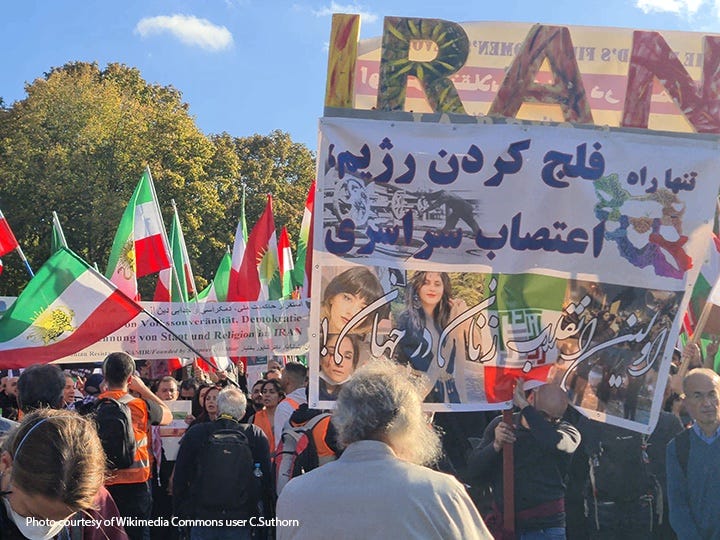
For decades, the Islamic Republic of Iran has been one of the most influential yet controversial governments in the Middle East.
Iran has survived war, heavy sanctions, mass protests, and even international isolation. Yet, it appears as if Iran is now at an unstable point that could escalate to unprecedented levels.
While the Republic has not fallen, recent developments have involved a rapid currency decline, nationwide protests, and ever-expanding government intervention.
The most direct cause? The economy.
Iran’s worsening economic climate, driven by its collapsed currency, with a 42.5% inflation rate in December, according to Reuters.
For ordinary people in Iran, this isn’t just a statistic for them. It directly translates day-to-day, with many people struggling to pay for groceries or rent, with poverty reaching astonishing levels.
Even those who avoid politics are being forced to confront the unfortunate reality of the world, in which a government’s failures can directly affect their ability to live.
Protests began on December 28, 2025, with a majority of them spreading across multiple regions of Iran, growing in both size and intensity.
Originally, protesters demanded economic certainty and reform, but now it’s been shifted toward questioning the legitimacy of the government.
Iran’s response? Aggressively telling.
Rather than negotiation or promises of reform, the government has turned to military escalation to solve problems at home.
According to many verified reports, including one from the AP, Iran’s government has been limiting/turning off internet access for its people in an attempt to silence the majority.
In addition to digital suppression, Iran has reportedly targeted businesses and private properties, with their justification being “connected to alleged protest support.”
When a state of any kind begins to crack down on assets, businesses, and personal rights, it signals to the world that the government is no longer trying to support its people, but itself.
Even though we give these bodies of influence their power, many are scared to take action, and for good reason.
Human rights groups estimate that around 4,500 protesters have been killed. Although independent verification of that number is difficult, as basic death toll reports cannot be taken seriously due to the politicization of the numbers, as seen in Israel.
As violence escalates further, international bodies have stepped in to investigate.
The U.N Human Rights Council has reportedly scheduled an emergency session regarding the violence and mass arrests in Iran.
Emergency sessions are very rare and tend to only happen when international organizations believe a situation has become worryingly severe.
Iran is losing its most powerful tool, legitimacy with its people. When a society begins to question its leaders, historically, they’ve begun to disobey.
Unsurprisingly, these combinations of events have sparked a very dangerous cycle, with protests leading to repression and death, repression and death leading to outrage, and outrage sparking even bigger protests.
Taking the scope outside of Iran, one New York Times report describes Iran’s state media issuing unusually direct threats towards the President of the United States, Donald Trump, stating that “This time it will not miss the target,” in reference to his assassination attempt in Butler, Pennsylvania in 2024.
When regimes begin to lose support, their internal insecurity turns toward external conflict to unify supporters against a common enemy.
However, escalations like this can only do more harm. President Trump has commented on this threat, stating that Iran would “be wiped off the face of the Earth” if something happens to him, per The Hill.
Even if the leader of Iran were to be ousted tomorrow, the transition would take a long time to take effect. Still, it is very clear that Iran is no longer dealing with routine protests or irregular economic downturn, but rather an accelerating crisis that threatens its current integrity, as well as the future of its foundations.
Whether or not Iran remains after the conflict, the state is entering a time period where any movement has the potential to shape its direction for years to come, and possibly the Middle East as a whole, as well.